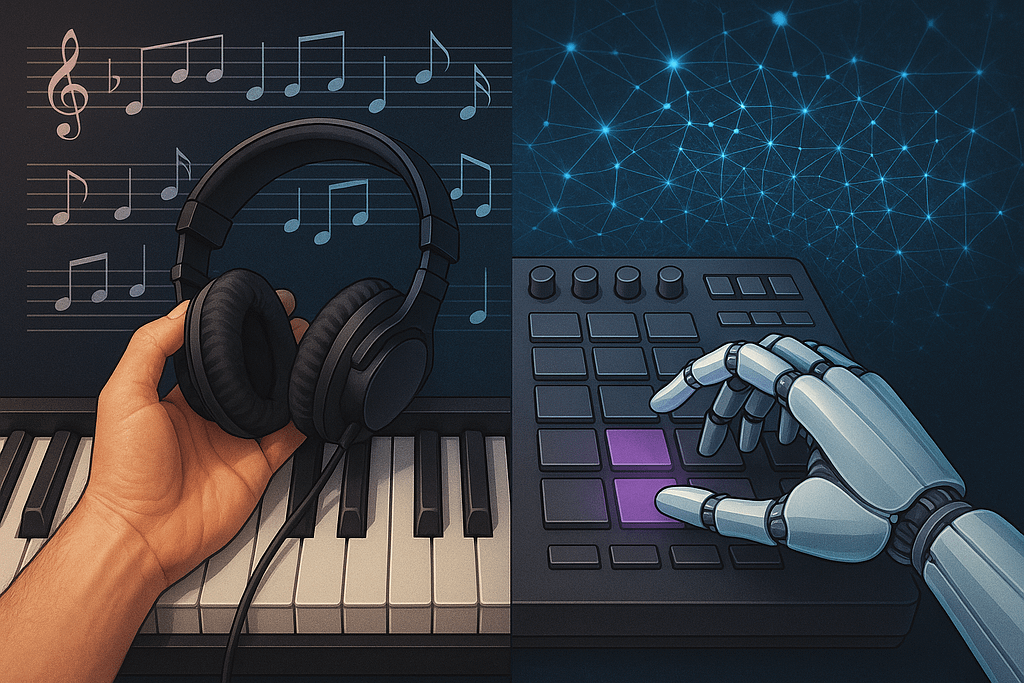
Artificial intelligence might feel like a modern miracle, but its roots stretch back further than you might think — and it’s already left its mark on music. From early experiments to today’s powerful composition tools, AI is changing the way we make, listen to, and even think about music.
A Brief History of AI (and Music)
AI as a concept began taking shape in the 1950s. Alan Turing’s 1950 paper “Computer Machinery and Intelligence” posed the now-famous question: “Can machines think?” That led to the Turing Test — still a benchmark for judging machine intelligence today.
By 1956, the term “artificial intelligence” was coined at a workshop hosted by computer scientist John McCarthy. From there, progress ticked along, with notable milestones like:
- 1952: A computer learns to play draughts on its own.
- 1961: An IBM computer sings “Daisy Bell” — the first computer-generated song.
- 1968: ELIZA, an early chatbot, lays the groundwork for tools like ChatGPT.
By the 1990s, AI started sneaking into everyday life — voice recognition, vacuum cleaners, Netflix recommendations. Fast-forward to the 2020s, and tools like ChatGPT and DALL·E aren’t just impressive — they’re reshaping industries, including music.
So What Is AI?
At its core, AI is about getting computers to do things that usually require human intelligence. But it’s not just one thing — it’s made up of several moving parts:
- Machine Learning (ML): Systems learn from data and improve over time without being directly programmed. It’s great for recognising patterns — like detecting beats, mood, or genre in music.
- Neural Networks: Loosely modelled on the brain, these networks “learn” to do complex tasks — like generating realistic vocal sounds or new melodies.
- Deep Learning: Think of this as neural networks with extra layers. These systems handle more data and produce more nuanced results. Tools like iZotope RX 10 use deep learning to clean up audio with scary-good precision.
How AI Is Used in Music Today
AI isn’t replacing musicians — it’s teaming up with them. There are now over a hundred AI-powered tools designed for various aspects of music-making. Here are just a few things AI can do:
Songwriting & Composition
Need a melody or backing track? Tools like Aiva, Boomy, and Melody Sauce can generate original compositions based on your input.
Lyrics & Ideas
Struggling with writer’s block? Lyric generators can throw you a few lines to get started.
AI Music Production Tools
From suggesting EQ settings to generating whole arrangements, AI can now assist in sound design, mixing, and mastering. Try iZotope Ozone or Landr for automated mastering.
Noise Reduction & Audio Repair
Fix that dodgy recording in seconds. iZotope RX 10 uses deep learning to eliminate background noise and repair audio glitches.
Audio Separation
Want the vocals from a track, minus the drums? Tools like LALAL.AI and Spleeter can isolate elements from fully mixed songs.
Marketing & Merch
AI doesn’t stop at sound. It can generate promo copy, create social media graphics, design logos, and more. Need a music video or lyric visualiser? Some tools will generate them from your song automatically.
What About Buzzwords? Let’s Demystify a Few
You’ve probably seen these terms flying around — here’s what they mean:
- Chatbot: A program that mimics human conversation. Examples include ChatGPT, Claude, and Gemini.
- Generative AI: AI that creates new content — music, images, or text — based on what it’s learned.
- Large Language Models (LLMs): Like ChatGPT, these are trained on massive amounts of text so they can respond in human-like ways.
- Machine Learning: AI that learns from labelled data. Think of it like giving it recipes and letting it invent its own.
- Neural Networks: Layers of logic that spot patterns in sound, speech, or music.
- Deep Learning: Supercharged neural networks. Think of it like a wedding cake of learning: rich, layered, and carefully built.
Try It for Yourself — AI Music Platforms
Text-to-Music
Music Composition
Final Thoughts
AI isn’t here to take the soul out of music — it’s here to expand your toolkit. Whether you’re a pro producer or a curious beginner, AI can help you create faster, fix problems more easily, and maybe even inspire new directions.
Just like synthesisers didn’t kill off acoustic instruments, AI won’t replace musicians — but it might just help you make your best track yet.
Want More AI + Music Tips?
Let me know in the comments or drop me a message — and if you’ve tried any of these tools, I’d love to hear your thoughts.
If you are unfamiliar with some of the terms used here and elsewhere in my blog then you may find the definition in the GLOSSARY section of this site.

I would be interested in hearing about new developments that are designed to aid, rather than replace, human talent.
Thanks for your comment Mr Baldwin. From what I have read most A.I. companies claim that their aim is to relieve humans from repetitive tasks allowing them to concentrate on more creative work. I remain somewhat sceptical but I’ll continue to comment as I find. Please do keep coming back here as there will be something new almost every week sometimes more. DeeBee
Great point Graham — and it’s a really important distinction. While some AI tools aim to replicate music creation, many are designed to support and enhance human talent rather than replace it. For example, AI tools like AIVA assist composers in creating background music while still allowing them to tweak and refine the output. Endlesss is another platform that helps musicians collaborate in real time, using AI to generate beats and loops while keeping the creative process in human hands. And tools like Landr and iZotope use AI to assist with mixing and mastering, taking care of technical tasks so musicians can focus on their artistry.
Thanks for your interest — I’ll keep an eye out for more examples to share!
DeeBee
I like the idea that it can repair audio and eliminate background noise but I’m worried about AI writing music and lyrics. Will we know if songs have been created by Ed Sheeran or AI?
Thanks for your comment June! You’ve raised a really interesting point. AI can certainly repair audio and reduce background noise, which is great for enhancing sound quality. But when it comes to creating music and lyrics, things get a bit more complicated. AI can generate songs that sound like they were written by a particular artist, but there are usually ways to detect it, such as looking for specific patterns or analysing metadata.
Artists like Ed Sheeran bring a unique human touch and personal experience to their music — something AI can’t truly replicate, despite its technical capabilities. But it’s definitely a topic to keep an eye on as AI continues to evolve. Thanks for reading, and feel free to share more of your thoughts!
DeeBee